Electronic Variable Speed Drives
Variable Frequency Drive (VFD) Basics
-
Question 1
List the three main sections of a VFD and describe the function of each.
Reveal answerA VFD has three basic sections—the converter, the DC filter, and the inverter.
- The converter section rectifies the AC into DC.
- The DC filter provides a smooth, rectified DC, and
- The inverter switches the DC on and off so rapidly that the motor receives a pulsating DC that appears similar to AC.
-
Question 2
Describe the difference between a VVI and a CSI type inverter.
Reveal answerIn a VVI, the DC voltage is controlled, and the DC current is free to respond to the motor needs. The VVI uses a converter, a DC link, and an inverter to vary the frequency of the applied AC voltage.
The VVI shown in the schematic diagram in Figure 1 is divided into three basic parts—the converter, the DC link, and the inverter. Basically, three-phase AC is applied to the converter stage of the VVI. Naturally, this AC has both fixed amplitude and fixed frequency. The converter rectifies the AC into DC, which is then smoothed by the DC link. This filtered DC is applied to the inverter, which chops the DC into pulsating AC. This AC is then applied to the motor. The chop-ping rate applied to the DC varies the frequency of the AC applied to the motor.
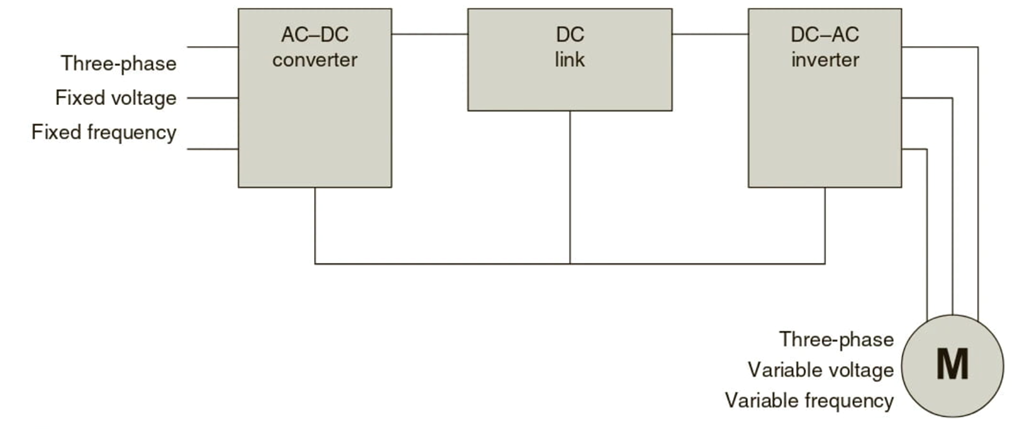
Variable Voltage Inverter (VVI) Block Diagram
The CSI, or current fed inverter, is a type of inverter drive in which the current is controlled while the voltage is varied to satisfy the motor’s needs. To accomplish these tasks, a large inductor is used in the DC link section. In the VVI, a large capacitor is used to keep the DC voltage constant. A capacitor opposes a change in voltage. In the CSI, a large inductor is used to keep the DC current constant. An inductor opposes a change in current.
-
Question 3
How is pulse width modulation accomplished?
Reveal answerPulse width modulation is accomplished by controlling the on/off times of the power SCRs in response to the desired motor speed versus the actual motor speed.
-
Question 4
What component is used to maintain a steady voltage in a VVI?
Reveal answerA capacitor is used to maintain a steady DC voltage in a Voltage-Source Inverter (VVI). The capacitor is installed in the DC link section of the drive and opposes changes in voltage, helping keep the DC bus voltage relatively constant as the inverter operates.
-
Question 5
What component is used to maintain a steady current in a CSI?
Reveal answerAn inductor is used to maintain a steady DC current in a Current-Source Inverter (CSI). The inductor is placed in the DC link section and opposes changes in current, helping keep the current relatively constant while the inverter varies voltage to meet the motor’s operating requirements.
-
Question 6
Name two benefits and two disadvantages of a VVI with phase control.
Reveal answerBenefits Disadvantages Can handle undersized motors. Produces torque pulsations at low speed. Can operate in regenerative mode. Does not provide short-circuit protection in the output stage. -
Question 7
Name two benefits and two disadvantages of a VVI with chopper control.
Reveal answerBenefits Disadvantages Can operate from batteries. Requires high-speed switching devices. Can handle undersized motors. Produces torque pulsations at low speed. -
Question 8
Name two benefits and two disadvantages of a CSI with phase control.
Reveal answerBenefits Disadvantages Provides short-circuit protection in the output stage. Produces torque pulsations at low speed. Can handle oversized motors. Cannot operate from batteries. -
Question 9
Name two benefits and two disadvantages of a CSI with chopper control.
Reveal answerBenefits Disadvantages Can operate from batteries. Produces more electrical noise due to high-speed switching. Provides short-circuit protection in the output stage. Produces torque pulsations at low speed. -
Question 10
Name two benefits and two disadvantages of a three-phase induction motor controller.
Reveal answerBenefits Disadvantages Provides excellent speed regulation and motor performance. More complex and expensive than VVI or CSI drives. Produces smooth torque with low pulsation. Requires sophisticated control and switching circuitry.
